
Most production boats over about 35 feet now come with a bow thruster from the factory, and for normal conditions it usually does the job. A typical 45–50 foot production boat is fitted with a thruster that can hold the bow against a direct crosswind of about 21–23 knots. Custom and high-end builds often go further, with high-power systems rated for 24–26 knots.
If you regularly deal with strong wind, a marina with heavy current, or you just want more control, you can step up to a more powerful system. Very few pleasure boats ever need more than that 24–26 knot range, though.
What actually determines thruster size
It's mostly not the weight of the boat. Thruster performance depends on three things:
- Wind area: the total side profile of the boat that the wind pushes against.
- How that area is distributed: windage concentrated forward takes more thrust to control than windage set aft.
- Where the tunnel sits: the farther forward the thruster, the more leverage it has around the boat's pivot point.
Put together, the two questions that matter are: how much wind area does your boat have, and how much wind do you want to be able to handle?
Why thruster position matters
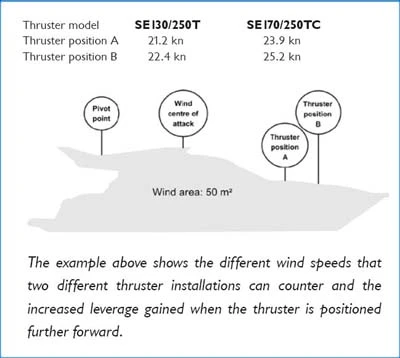
On the same boat, with 50 m² of wind area, moving the tunnel farther forward adds roughly a knot and a half of crosswind capability, whichever thruster is installed:
| Thruster | Position A (aft) | Position B (forward) |
|---|---|---|
| SE130/250T | 21.2 knots | 22.4 knots |
| SE170/250TC | 23.9 knots | 25.2 knots |
Thruster sizing by boat length
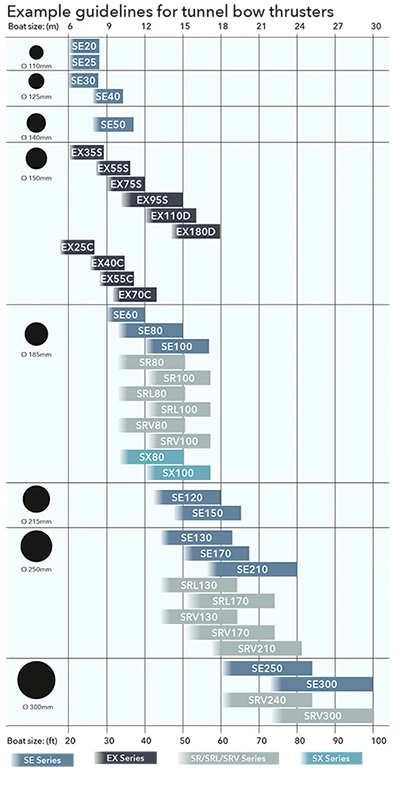
Use this table as a starting point. Find your boat's length, then look at the models in that range. Within each tunnel size, the higher model number gives more thrust and handles more wind. Boats with high, forward-heavy superstructures (flybridges, tall hardtops) should lean toward the upper end.
| Tunnel diameter | Model | Approx. boat length |
|---|---|---|
| 110 mm | SE20 | 20–28 ft |
| SE25 | 20–28 ft | |
| 125 mm | SE30 | 20–27 ft |
| SE40 | 26–34 ft | |
| 140 mm | SE50 | 27–37 ft |
|
150 mm EX series |
EX25C | 18–26 ft |
| EX35S | 20–33 ft | |
| EX40C | 25–35 ft | |
| EX55S | 27–36 ft | |
| EX55C | 28–38 ft | |
| EX75S | 30–40 ft | |
| EX70C | 32–42 ft | |
| EX95S | 34–49 ft | |
| EX110D | 40–52 ft | |
| EX180D | 47–59 ft | |
| 185 mm | SE60 | 30–40 ft |
| SE80 | 34–49 ft | |
| SE100 | 40–56 ft | |
| SR80 / SRL80 / SRV80 | 33–45 ft | |
| SR100 / SRL100 / SRV100 | 40–56 ft | |
| SX80 | 34–49 ft | |
| SX100 | 40–56 ft | |
| 215 mm | SE120 | 42–59 ft |
| SE150 | 47–65 ft | |
| 250 mm | SE130 | 44–62 ft |
| SE170 | 50–66 ft | |
| SE210 | 55–79 ft | |
| SRL130 / SRV130 | 44–58 ft | |
| SRL170 / SRV170 | 50–73 ft | |
| SRV210 | 57–80 ft | |
| 300 mm | SE250 | 60–83 ft |
| SE300 | 72–100 ft | |
| SRV240 | 60–83 ft | |
| SRV300 | 72–100 ft |
Series shown: SE, EX, SR/SRL/SRV (retractable) and SX. Ranges are general guidelines based on Sleipner's published chart, not a substitute for a boat-specific calculation.
Prefer the original chart? Here's Sleipner's guideline graphic:
Get a calculation for your boat
These charts are general guidelines. For an exact recommendation, a calculation can be run from your boat's side-profile drawing, taking in wind area, superstructure placement and tunnel position. Contact Captain's Locker with your boat's make, model, length and a profile drawing or photo if you have one, and we'll help you get a boat-specific recommendation.